

Lower Carbon, Higher Cost: The Environmental Trade-Offs Businesses Can’t Ignore
Cutting carbon emissions can create other environmental problems. Boundless research shows how a product with a low carbon footprint can still harm water, air quality, or human health, and how Life Cycle Assessment (LCA) helps companies spot these trade-offs.
Carbon emissions have become the main measure of sustainability. They drive net-zero targets, shape carbon calculators, and influence product claims. However, focusing on carbon alone can leave important environmental impacts unnoticed.
A product might produce fewer greenhouse gas emissions while consuming more water or causing more air pollution. These are environmental trade-offs: reducing one impact while increasing another.
What Our Energy Storage Study Revealed
Boundless completed a full Life Cycle Assessment of a commercial-scale, long-duration energy storage system. This all-electric technology stores excess renewable electricity and reuses its own heat.
We measured greenhouse gas emissions alongside water use, fossil energy consumption, and particulate matter air pollution.
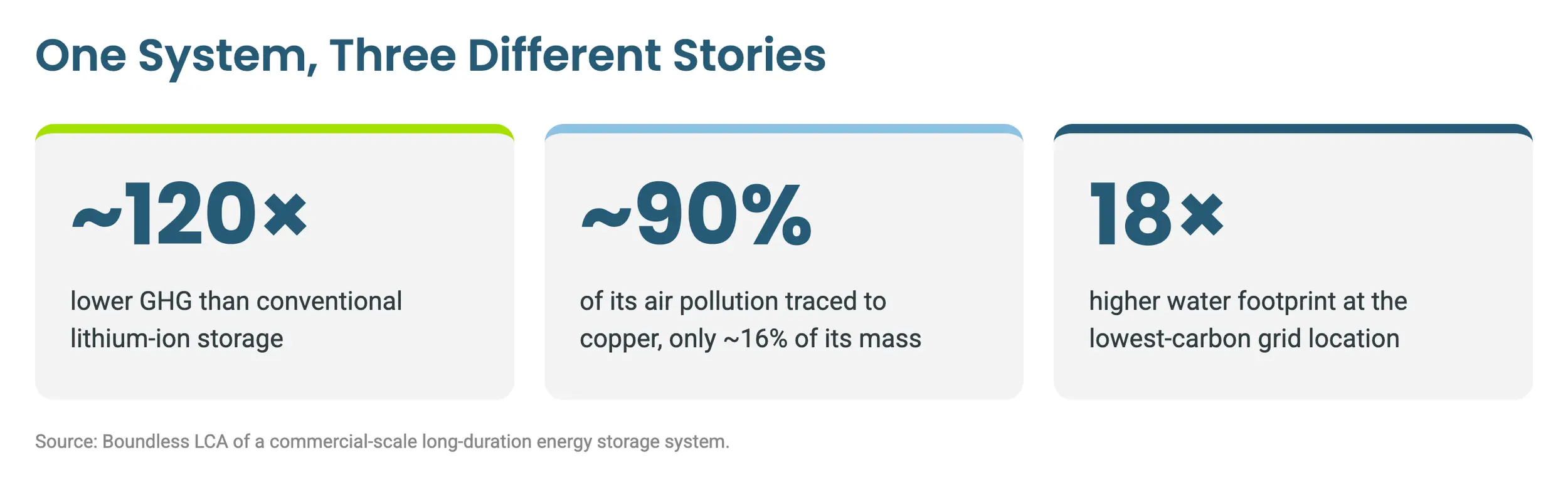
The system produced roughly 120 times fewer greenhouse gas emissions than conventional lithium-ion storage, with the best results when storing wind energy. However, other measurements revealed impacts that carbon alone would have missed.
Hidden Cost #1: Air Pollution From Copper
Copper made up just 16% of the system’s total mass but caused about 90% of its particulate matter air pollution.
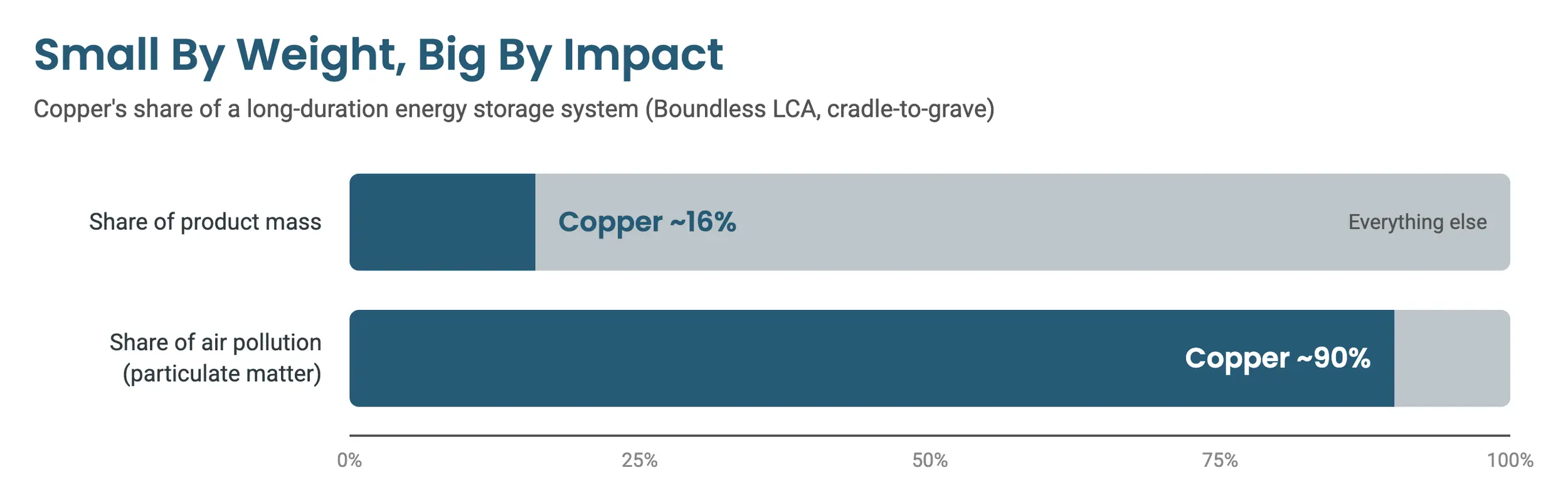
Mining and refining copper require substantial energy and release particles that can harm human health. A carbon footprint alone would not reveal the scale of this problem.
The company could source recycled copper, choose suppliers with cleaner refining processes, or redesign the system to use less copper.
Hidden Cost #2: More Water Use on a Cleaner Grid
The system charges using grid electricity, so its environmental impact depends partly on where it operates.
Our modeling found that the Ontario grid location with the lowest greenhouse gas emissions also had the highest water footprint, at approximately 18 times the baseline.
Low-carbon electricity does not automatically mean low water use. Ontario relies heavily on nuclear and hydropower, which can have significant water impacts through cooling and reservoir evaporation.
Choosing a location based on carbon emissions alone would have missed this trade-off.
A simple carbon calculator would not have revealed either problem.
Environmental Trade-offs Across Other Industries
These trade-offs occur across many industries, not just energy storage.
- Electric vehicles reduce tailpipe emissions, but mining rare earth metals used in some permanent-magnet motors can cause soil and water contamination, radioactive waste, and harm to human health.
- Hydropower generates electricity with low carbon emissions, but reservoirs in drought-prone regions can reduce water available to farms and communities.
Why These Trade-offs Matter to Businesses
Overlooking environmental impacts creates two major business risks.
- Claims risk: EU environmental claims rules can restrict misleading statements about product benefits. Calling a product “lower impact” based only on carbon emissions could be misleading if other impacts increase. Companies should verify applicable requirements before making such claims.
- Supply chain risk: Materials and locations associated with high water use or pollution may face tighter regulations, rising costs, and community opposition. Identifying these risks early supports better sourcing and investment decisions.
How Life Cycle Assessment Reveals the Full Picture
Life Cycle Assessment measures a product’s environmental impacts throughout its life cycle, from raw material extraction to disposal or recycling. Following ISO 14040 and 14044 standards, a multi-impact LCA can assess climate change, water use, air pollution, toxicity, land use, and resource depletion. It also helps companies trace each impact to the material, process, supplier, or location responsible for it.
A carbon footprint shows how a product performs on climate emissions. An LCA reveals how it performs across several environmental measures, helping companies understand the trade-offs before making decisions.
For a side-by-side comparison, see our guide to carbon calculators versus Life Cycle Assessment.
The full white paper works through this analysis in depth, including how product category rules make LCA results comparable, how new EU rules are changing what companies can claim, and two Boundless case studies on long duration energy storage and steel production.
How Boundless Helps Identify Hidden Impacts
Boundless Impact Research & Analytics conducts multi-impact Life Cycle Assessments for advanced technologies and sustainable products. Our LifeCycle IQ platform tracks carbon emissions alongside water use, energy consumption, and air pollution. It helps teams identify the main sources of environmental impact and compare alternatives, such as different suppliers, materials, or production locations, before committing to a decision. Third-party verification is also available when independent review is needed.
See It in Action with LifeCycle IQ
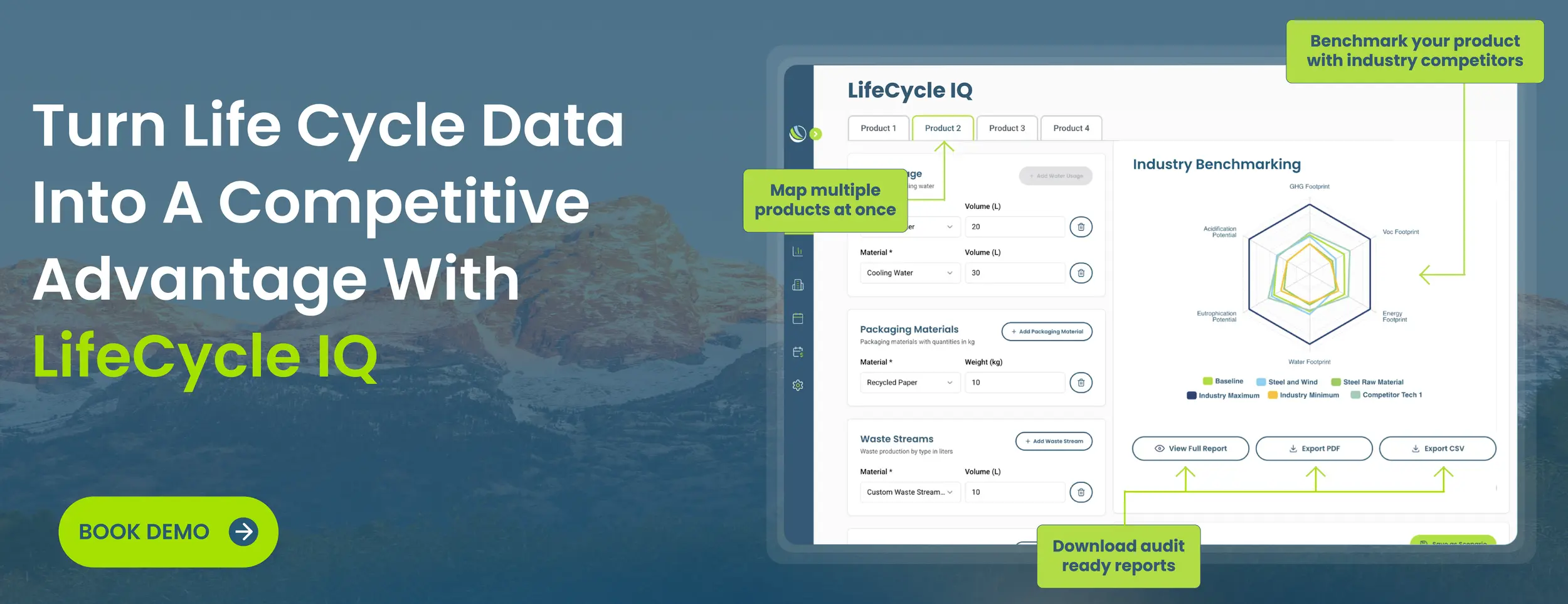
The white paper lays out the thinking. LifeCycle IQ is where it becomes a working tool. Our platform combines product-level LCA and cost analysis, benchmarked against 450+ industries, so you can compare suppliers, materials, and scenarios in one model that updates as your product changes — instead of a static study that's outdated in months.
Book a short call to see how your products perform beyond carbon, from water use to particulate matter.


