

EU Green Claims Ban: Your Sustainable Label Now Needs Proof
As of September 27, 2026, the EU green claims ban makes vague green marketing a legal liability. Companies with sustainable products will need to back every claim with product specific evidence, and Life Cycle Assessment provides evidence to prove it.
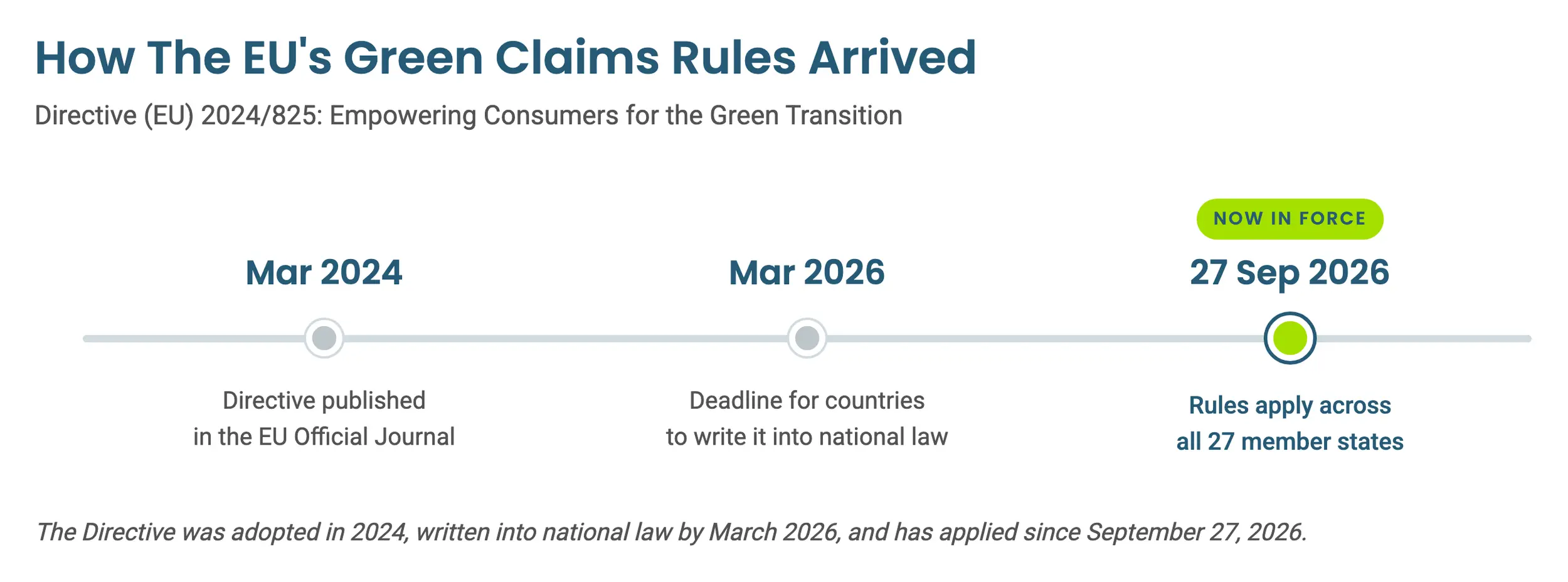
For years, “eco-friendly,” “green,” and “carbon neutral” did a lot of work on packaging and product pages. They were easy to print and hard to challenge. That era ended on September 27, 2026.
On that date, the EU green claims ban took effect. The Empowering Consumers for the Green Transition Directive (Directive 2024/825) now applies across all 27 member states. It rewrites the rules for environmental claims made to consumers, and it applies to any company selling into the EU, wherever it’s headquartered. Enforcement runs through national consumer protection authorities, and in coordinated cross-border cases, fines can reach 4% of annual turnover.
What the EU green claims ban prohibits
The Directive bans several practices outright and sets strict conditions for others. The most important for product companies are:
- Generic environmental claims without proof: Terms like “eco-friendly,” “green,” “climate friendly,” or “environmentally friendly” are banned unless the company can demonstrate recognized environmental performance standards relevant to the claim. In practice, that means certification under the EU Ecolabel or an equivalent officially recognized Ecolabel.
- Offset-based product claims: Claiming a product is “carbon neutral,” “climate neutral,” or has a “reduced CO₂ impact” because the company bought carbon credits is now prohibited outright.
- Self-made sustainability labels: Labels must be based on an independent certification scheme or established by a public authority.
- Overstating the scope of a benefit: A claim about a whole product when the benefit applies to only one part, such as the packaging, is banned.
- Unsupported future claims: Pledges like “net zero by 2040” now need a clear, verifiable implementation plan reviewed by an independent third party.
What’s still allowed: specific, measurable claims
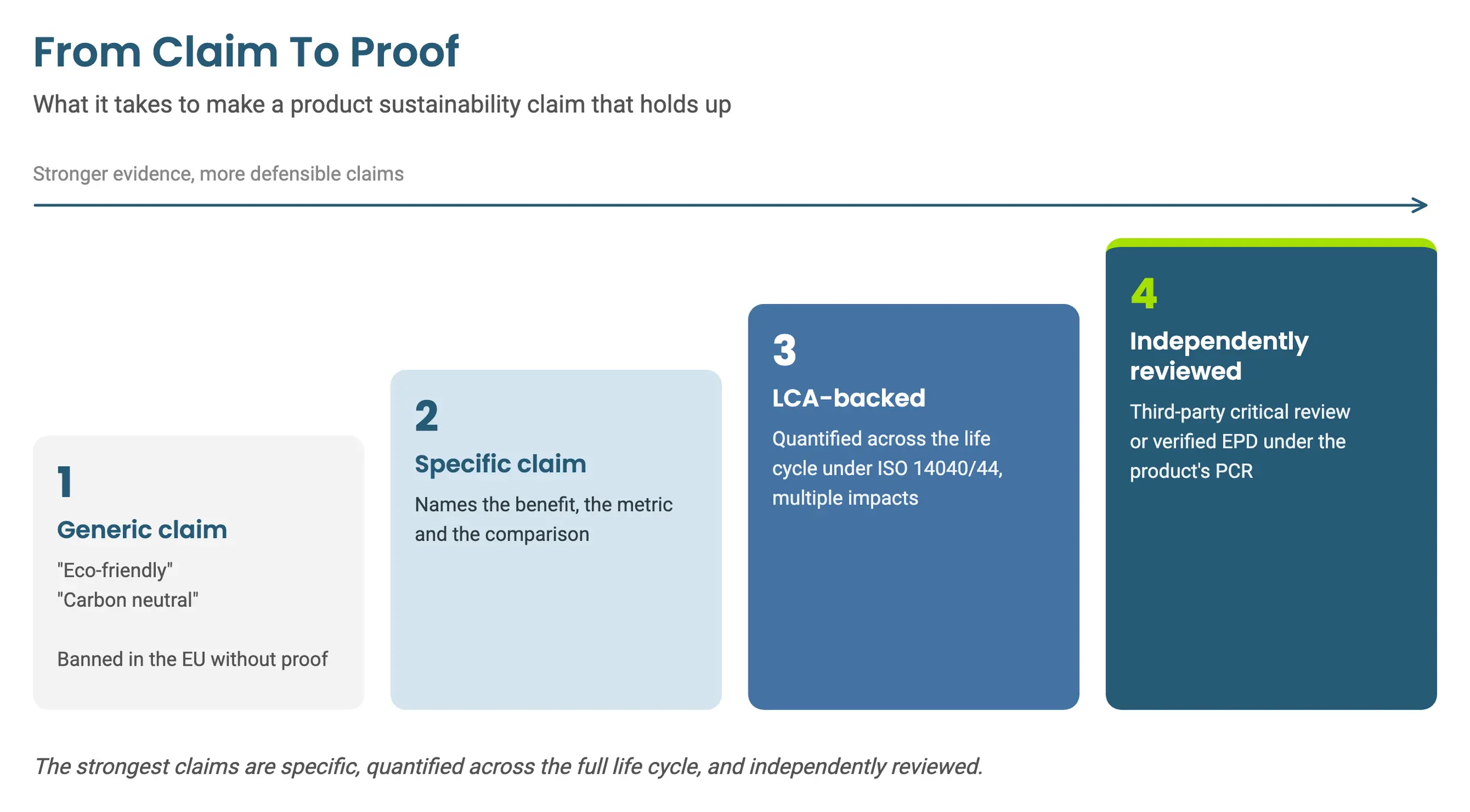
The Directive doesn’t silence sustainability marketing, it raises the bar. Specific claims that name the benefit, the metric, and the comparison remain allowed, provided the company can prove them. Here’s what that shift looks like in practice:
Before (Now banned or high-risk) | After (specific and provable) |
|---|---|
Eco-friendly packaging | Made with 60% post-consumer recycled plastic, cutting packaging emissions by 35% compared with our 2024 design. |
Carbon neutral shipping (based on offsets) | We cut delivery emissions per order by 22% since 2024 by shifting to rail. We also fund verified carbon removal projects. |
Green concrete | Global warming potential of 210 kg CO₂e per m³, 30% below the regional average, per our verified EPD. |
Notice what every “after” claim has in common: a number tied to a specific product, a defined comparison, and a method behind it. That’s the part most companies don’t yet have.
Green claims compliance is an evidence problem
Most companies’ sustainability data lives in a corporate carbon inventory: Scope 1, 2, and 3 emissions estimated with a carbon calculator. That inventory is useful for managing a company’s overall footprint, but it was never designed to prove anything about a single product. Much of it is built from cost-based averages, and it is aggregated at the company level.
Product Carbon Footprint gets closer, but it only measures greenhouse gases. That creates a quieter risk under the new rules. If you claim a product has a “lower environmental impact” based on carbon alone, while its water use or air pollution went up, you may be overstating the scope of the benefit, which is now explicitly banned. This kind of burden shifting is more common than most companies expect.
A product-level claim needs product-level evidence. A Scope 1, 2, 3 inventory can’t provide it.
Life Cycle Assessment measures true sustainability performance
Life Cycle Assessment (LCA) measures a product’s environmental impact from raw material extraction through manufacturing, use, and disposal or recycling. It follows the international standards ISO 14040 and 14044, and it maps closely to what regulators now expect from a claim:
- Specific: LCA is built around one product and a defined functional unit, such as one square meter of insulation or one kilowatt-hour stored, not a company average.
- Measurable: It quantifies impacts with documented data sources and assumptions.
- Complete in scope: A multi-metric LCA tracks water use, air pollution, toxicity, and land use alongside carbon, so you know whether a benefit is real across the board or only on one metric.
- Comparable: Product category rules (PCRs) set shared methods for each product type, so results can be compared with competitors on equal terms.
- Verifiable: ISO 14044 requires independent critical review for public comparative claims, and Environmental Product Declarations (EPDs) are third-party verified.
For a side-by-side look at each tool, see our guide to Carbon Calculator vs. Life Cycle Assessment.
The full white paper works through this analysis in depth, including how product category rules make LCA results comparable, how new EU rules are changing what companies can claim, and two Boundless case studies on long duration energy storage and steel production.
Don’t go quiet: replace generic claims with specific ones
Some companies will respond to the new rules by saying nothing at all. That’s a mistake. Buyers, investors, and procurement teams still want to know which products are genuinely better, and silence hands that conversation to competitors who can prove their numbers.
The better path is to replace every generic claim with a specific one you can defend. Start with an audit of the claims you make today, identify the ones a regulator could challenge, and build the product LCA inventory and evidence to support the claims that matter most to your business.
How Boundless helps you prove product claims
Boundless Impact Research & Analytics builds ISO 14040/44 Life Cycle Assessments for advanced technologies and sustainable products. Our LifeCycle IQ platform models your specific product, functional unit, and system boundary, tracks carbon alongside water, energy, and air pollution, and documents every data source, so each claim is traceable to its evidence. When a claim calls for independent review, third-party verification is available.
The result is sustainability marketing you can stand behind, in the EU and everywhere else.
See It in Action with LifeCycle IQ
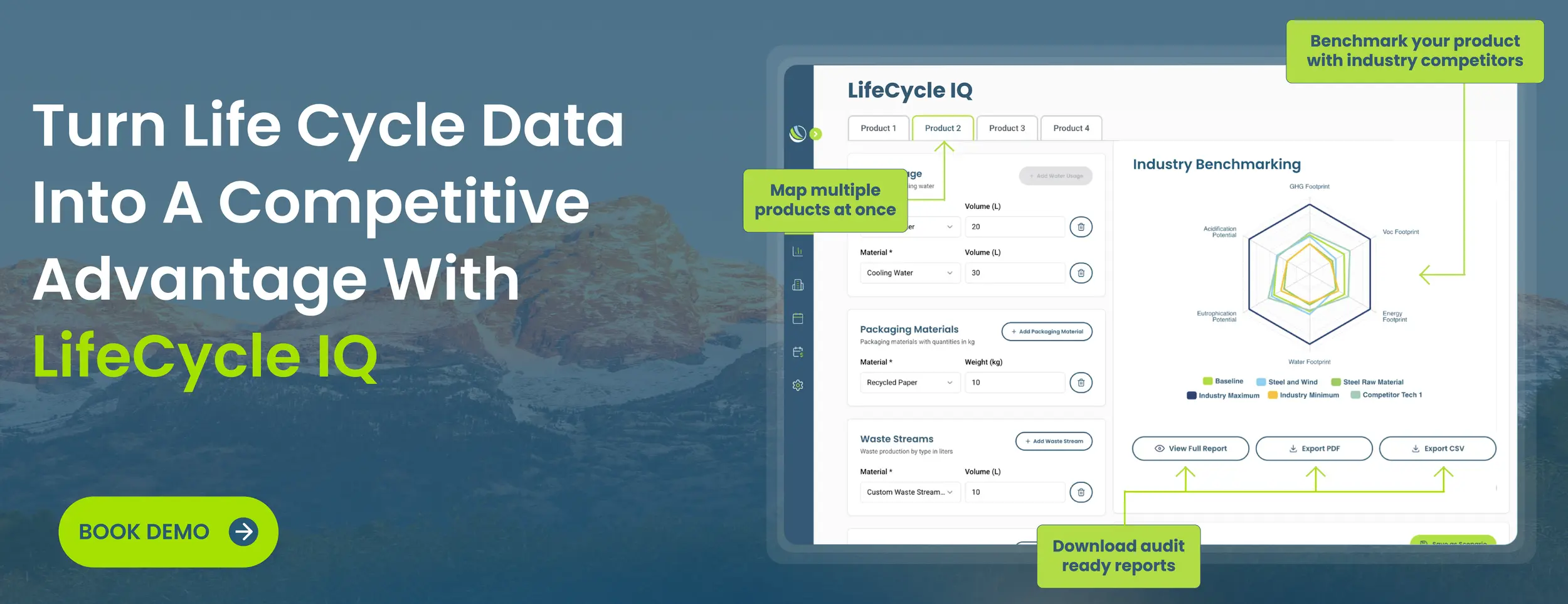
The white paper lays out the thinking. LifeCycle IQ is where it becomes a working tool. Our platform combines product-level LCA and cost analysis, benchmarked against 450+ industries, so you can compare suppliers, materials, and scenarios in one model that updates as your product changes — instead of a static study that's outdated in months.
Book a short call to see how your products perform beyond carbon, from water use to particulate matter.


