


Carbon Management and Accounting
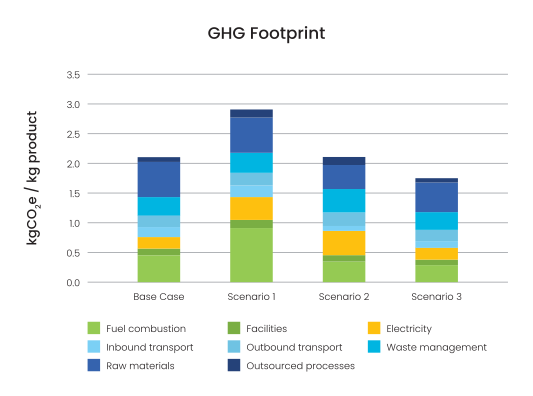
GHG Footprint Analysis
What is Boundless Greenhouse Gas Footprint Analysis? We analyze the GHG emissions footprint of products using ISO-Compliant Life Cycle Analysis (LCA) methods and compare them to competing products in their industry. Boundless compiles results into an investor-friendly document that includes written and graphic explanations of the research, industry benchmarks, industry expert feedback, and climate performance.
The Boundless team evaluates the climate impact of innovative technologies and products in order to help companies leverage their LCA to gain a strategic place in their industries. Driven by superior research from environmental scientists, engineers, and industry experts, we offer an objective and independent analysis of the GHG impact of leading technologies and products.
GHG Emissions Projections
GHG Emissions Projections calculate the GHG savings over time, compare traditional technologies to your company's technology, and consider different levels of market penetration. Carbon return on investment and cost metrics can be added at additional cost, to show how your environmental impact relates to commercialization.
Boundless determines performance over a specific period of time based on market analysis and expected production data and market penetration. The results provide compelling and defensible analytics that enable a company to showcase the long-term GHG savings and emissions performance of a product. It also shows how this growth enables a company to gain market share over time.
-opt-2500.WEBP)
Carbon Credit Advisory
Boundless advises companies on their carbon management and accounting strategies, including on carbon credit project development, and how to engage in and maximize their performance in sustainability markets. We help our customers develop carbon credit strategies, so they can take their life cycle performance improvements and turn them into a profit-making aspect of their business. We have a dedicated team of carbon management and accounting specialists who work with global corporate customers to facilitate their participation in the voluntary and regulated carbon credit markets.
We are also actively engaged by some of our customers to help them turn their positive life cycle performance into other commodities like plastic credits, water credits, and ecosystem credits. Please reach out to a Boundless team member to learn more.
Scope 1, 2, & 3 Inventories
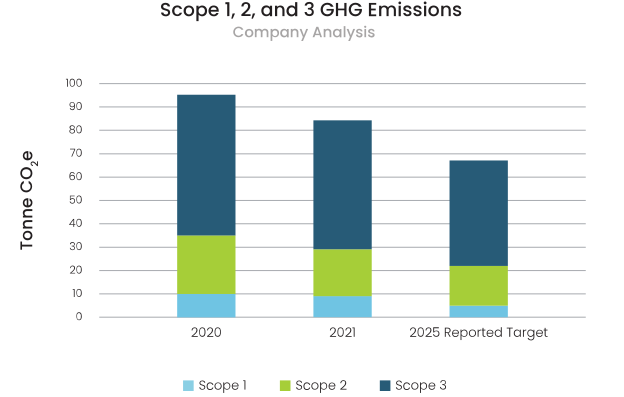
Independent and reliable accounting of GHG emissions is an important step for companies in developing long-term climate and sustainability strategies and goals. Boundless’ expertise in LCA enables us to efficiently analyze a company’s Scope 1, 2, and 3 GHG emissions. We provide a detailed accounting of emissions resulting from a company’s direct and indirect business activities, using globally standardized frameworks. We also include data visualization and analysis that investors and customers can easily interpret to understand emissions performance and progress over time.
GHG Scenario Analysis
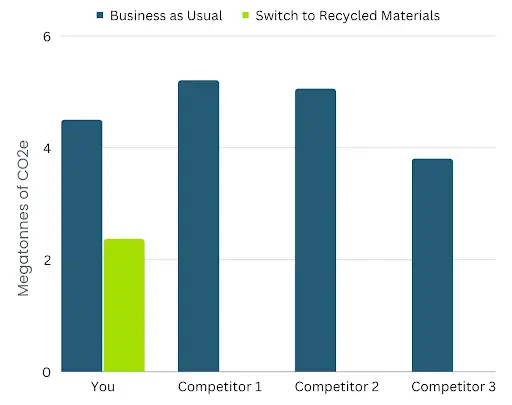
The Boundless GHG Scenario Analysis tool helps companies assess their current emissions levels, build realistic reduction scenarios, and develop strategies for more sustainable products and operations.
We can't predict the future, but Boundless GHG Scenario Analysis provides high-quality insights to guide your carbon reduction strategies. Armed with our modeling capabilities, you will reduce uncertainties on your path to a reduced carbon footprint, and figure out how to best tell your sustainability story.
Carbon Intensity Scoring
Boundless can provide Carbon Intensity Scores to companies seeking to take advantage of California’s Low-Carbon Fuel Standard (LCFS). Companies use CI Scoring to meet sustainability compliance requirements and get much-needed carbon credits to be competitive in their industry.
Carbon Intensity Scoring measures the amount of greenhouse gas emissions associated with a particular product or service and follows the Argonne National Lab’s GREET model to calculate emissions savings for transportation fuels such as gasoline, diesel, ethanol, biodiesel, and renewable natural gas. Carbon intensity scores can also be used to compare the environmental performance of different products and services and to identify opportunities for emissions reductions.
-opt-2500.WEBP)