

Beyond the Carbon Calculator: Why Product Decisions Need Life Cycle Assessment
The Takeaway
Carbon calculators were built for company reporting. When the question is whether one product performs better than another, a multi-metric LCA shows the answer across the product’s full life: on which metrics and by how much compared to competitors. That is the evidence regulators, buyers, and investors increasingly expect.
Most companies still rely on carbon calculators and company-wide emissions reports. Those tools track a company's total emissions well, but they can't show how a specific product performs or how it compares to a competitor's.
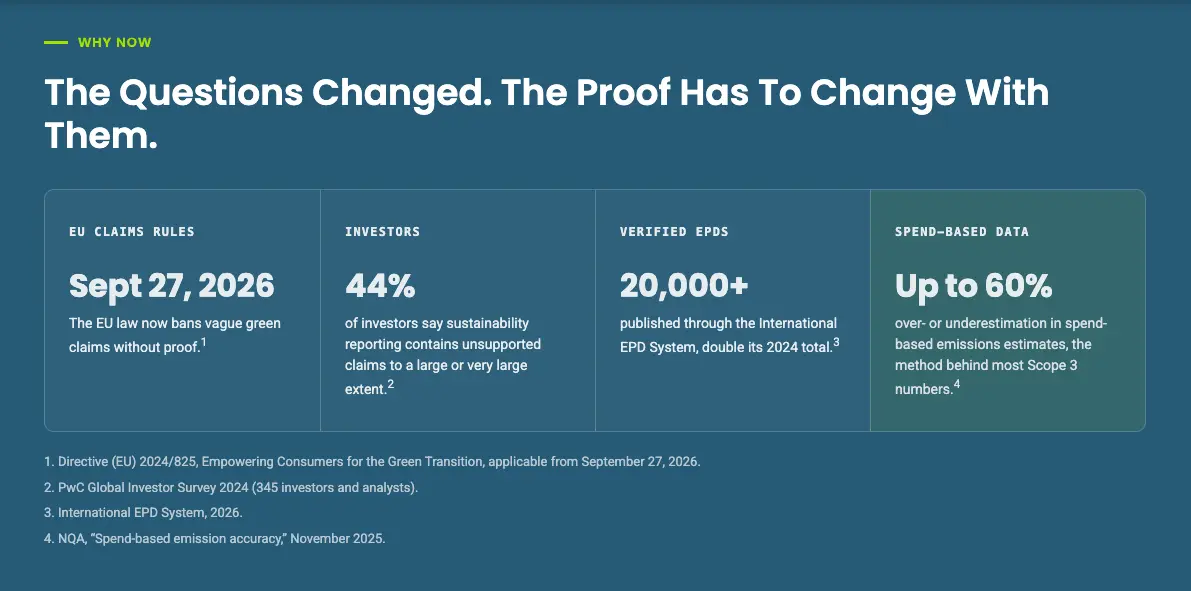
Why this is important now. As of September 27, 2026, EU law bans generic product claims like "eco-friendly" or "green" without proof, and "carbon neutral" product claims based on offsets are off the table entirely. Investors are skeptical too. In PwC's 2024 survey of investors and analysts, nearly half say company sustainability reports contain unsupported claims, and three in four put more trust in independently verified data.
What Is A Carbon Calculator?
Carbon calculators are the most commonly used software for estimating greenhouse gas (GHG) inventories of a company’s operation. They work by multiplying a company's cost data by standardized emission factors.

Shortcomings of Carbon Calculators
While carbon calculators have been useful in the past, they fall short for a few reasons:
- Inaccurate Scope 3 Estimates: Carbon calculators work well for calculating emissions that fall under Scopes 1 and 2, but for Scope 3 emissions, cost-based estimates often misrepresent actual carbon footprints by as much as 60%.
- Other types of pollution: Carbon calculators fail to capture aspects of pollution aside from GHG emissions. For example, soot is a short-lived air pollutant that heats the atmosphere and harms human health. To represent a product’s impact comprehensively, it is necessary to take into account different aspects of environmental damage.
- Other sustainability Impacts: Carbon calculators do not take into account impacts like water use or harmful chemicals such as volatile organic compounds (VOCs).
Carbon calculators only estimate one part of sustainability performance. Capturing the full picture requires methods that analyze the full life cycle of environmental impact.
What Is LCA?
For modern technology, calculating GHG emissions alone is not enough to provide a complete overview of a product’s sustainability impact. Multi-metric LCAs extend the sustainability analysis to other relevant impacts beyond carbon, such as water use, toxicity, or particulate matter (tiny particles of air pollution). In addition, LCAs used to compare a product against competitors must be independently reviewed under ISO 14044, making them more accurate and credible.
LCA is the internationally recognized method for measuring a product’s full sustainability footprint. Companies use it in three main ways:
- Validate sustainability performance with evidence that supports claims like “lower-carbon cement” for regulators, buyers, and investors.
- Find supply chain risk by tracing impacts back to the specific suppliers, materials, or regions that carry the largest footprint.
- Cut inefficiencies. The energy, water, and materials that drive a product’s footprint usually drive its cost too, so LCA hot spots often point straight to savings.
Carbon Calculator | Product Carbon Footprint | Life Cycle Assessment | |
|---|---|---|---|
Question it answers | How much does our company emit? | How much carbon is in this product? | Is this product actually better, on what, and by how much? |
Unit of analysis | The whole company | One product | One product, per defined functional unit |
Typical data | Typically spend-based industry averages | Activity-based product data | Activity-based product and supply chain data |
Impacts measured | Greenhouse gases only | Greenhouse gases only | Climate plus water, air pollution, toxicity, land use, and more |
Comparable across companies? | Rarely | Sometimes; methods vary | Yes, within a product category using PCRs |
Independent review | Usually self-reported | Optional | Required for public comparative claims |
Standards | GHG Protocol Corporate Standards | ISO 14067; GHG Protocol Product Standard | ISO 14040 and 14044; EN 15804 for construction |
Best for | Corporate reporting | Customer carbon data requests and targets | Product claims, EPDs, design and supply chain decisions |
When you need a Life Cycle Assessment
The moment the question shifts from your company to your product’s sustainability, a carbon calculator stops being enough. Use this guide:
If you need to… | Use… |
|---|---|
Report company-wide emissions for corporate compliance | A corporate GHG inventory (carbon calculator), ideally with activity data for major purchases |
Answer a customer’s request for your product’s carbon footprint | A product carbon footprint at minimum, or an LCA if they ask about your sustainability performance reporting |
Make a public sustainability claim about a product sold in the EU | An LCA with independent review. See the EU green claims ban. |
Publish an EPD to win tenders or meet building requirements | An LCA following the product’s PCR, third-party verified. See where scrutiny moved after the CSRD Omnibus. |
Compare suppliers, materials, sites, or design options | An LCA with scenario modeling |
Show buyers or investors that your product outperforms competitors | A comparative LCA with independent critical review |
How Boundless helps you move beyond the carbon calculator
As regulators, buyers, and investors shift to requesting product-level sustainability data, an internationally recognized methodology is needed to accurately quantify claims through independent verification and scientific rigor. Life Cycle Assessment is the tool that turns sustainability claims into verified proof.
Carbon calculators and broad “net-zero” claims are no longer enough to hold companies accountable for their sustainability footprint.
Boundless Impact Research & Analytics builds ISO 14040/44 Life Cycle Assessments for advanced technologies and sustainable products. Our LifeCycle IQ platform models your specific product, functional unit, and system boundary, tracks carbon alongside water, energy, and air pollution, and documents where company data, secondary datasets, and estimates are used. Your team can rerun scenarios as suppliers and processes change. When a claim calls for independent review, we have a deep bench of subject matter experts for third-party verification.
Download The White Paper
The full white paper works through this analysis in depth, including how product category rules make LCA results comparable, how new EU rules are changing what companies can claim, and two Boundless case studies on long duration energy storage and steel production.
See It in Action with LifeCycle IQ
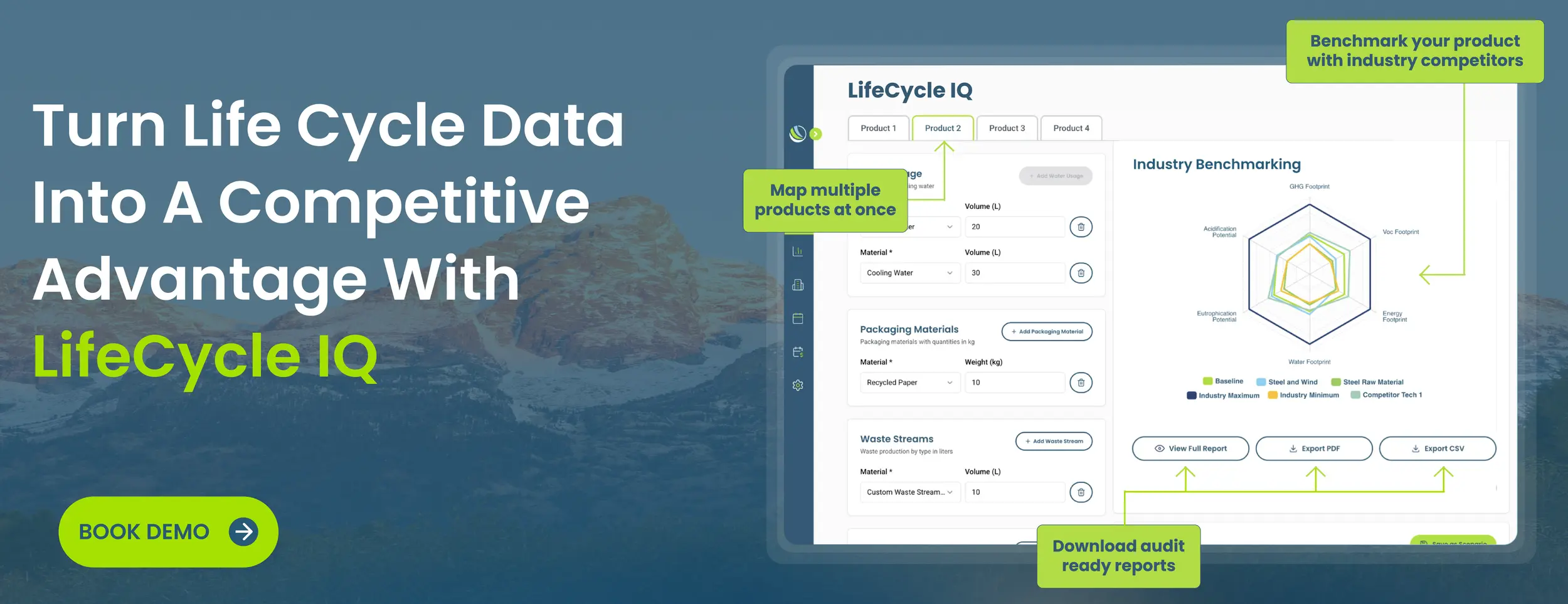
The white paper lays out the thinking. LifeCycle IQ is where it becomes a working tool. Our platform combines product-level LCA and cost analysis, benchmarked against 450+ industries, so you can compare suppliers, materials, and scenarios in one model that updates as your product changes — instead of a static study that's outdated in months.
Book a short call to see how your products perform beyond carbon, from water use to particulate matter.


