

Kuehnle AgroSystems: Advancing Sustainable Astaxanthin Production Through Dark Fermentation
The Challenge
Astaxanthin is a high-value antioxidant and red pigment widely used in food, cosmetics, and aquaculture. Today, most astaxanthin on the market is produced through conventional synthetic chemical processes, while alternative pathways such as light-grown microalgae and bacterial fermentation have emerged to meet demand for natural or biologically derived products. However, both biological production routes carry substantial environmental burdens. These processes are highly resource-intensive, with life cycle greenhouse gas emissions reaching up to 2,074 kg CO₂e per kilogram of astaxanthin, roughly equivalent to driving a gasoline-powered car more than 5,000 miles.
In addition, biological pathways impose significant water and land demands: bacterial fermentation requires approximately 3,210 liters of water per kilogram of astaxanthin, while light-grown microalgae cultivation can require up to 3,730 m² of land per kilogram—an area comparable to ten basketball courts. As demand for astaxanthin grows across multiple sectors, these environmental constraints present a critical scalability and sustainability challenge.
To address these issues, Kuehnle AgroSystems (KAS) sought to transform astaxanthin production by improving process efficiency and performance. Their approach aims to reduce resource intensity while maintaining product quality, enabling KAS to compete in a market where customers and investors increasingly prioritize low-impact, energy-efficient production systems.

The Challenge
Astaxanthin is a high-value antioxidant and red pigment widely used in food, cosmetics, and aquaculture. Today, most astaxanthin on the market is produced through conventional synthetic chemical processes, while alternative pathways such as light-grown microalgae and bacterial fermentation have emerged to meet demand for natural or biologically derived products. However, both biological production routes carry substantial environmental burdens. These processes are highly resource-intensive, with life cycle greenhouse gas emissions reaching up to 2,074 kg CO₂e per kilogram of astaxanthin, roughly equivalent to driving a gasoline-powered car more than 5,000 miles.
In addition, biological pathways impose significant water and land demands: bacterial fermentation requires approximately 3,210 liters of water per kilogram of astaxanthin, while light-grown microalgae cultivation can require up to 3,730 m² of land per kilogram—an area comparable to ten basketball courts. As demand for astaxanthin grows across multiple sectors, these environmental constraints present a critical scalability and sustainability challenge.
To address these issues, Kuehnle AgroSystems (KAS) sought to transform astaxanthin production by improving process efficiency and performance. Their approach aims to reduce resource intensity while maintaining product quality, enabling KAS to compete in a market where customers and investors increasingly prioritize low-impact, energy-efficient production systems.
The Technology
KAS has developed a proprietary dark fermentation process for producing astaxanthin using Haematococcus pluvialis, a microalga traditionally grown in light-dependent systems. This approach combines KAS’s optimized algal strains with conventional stainless-steel fermentation infrastructure, enabling cultivation in complete darkness rather than in open ponds or illuminated photobioreactors.
By shifting production to enclosed fermentation tanks, KAS achieves faster growth cycles, higher yields, and lower operating costs while eliminating the need for energy-intensive artificial lighting. As a result, annual production volumes are estimated to be 5-10 times higher than those of light-grown systems, with substantially lower resource requirements.
Compared to bacterial fermentation and light-grown microalgae, KAS’s process dramatically reduces spatial and material inputs. It requires approximately 98% less land than bacterial fermentation systems and avoids the extensive pond or greenhouse infrastructure needed for light-based cultivation. Water consumption is also reduced by roughly 85%, addressing a major constraint in large-scale biological production.
The resulting astaxanthin-rich biomass can be used in high-value applications such as dietary supplements, cosmetics, and aquafeed additives. By combining high productivity with a substantially smaller environmental footprint, KAS’s dark fermentation platform offers a scalable pathway to meet growing demand for natural astaxanthin while significantly lowering the environmental impacts associated with conventional biological production methods.
The Boundless Solution – ISO-Compliant Life Cycle Assessment
Boundless conducted an Environmental Impact Assessment (EIA) to evaluate KAS’s dark fermentation technology relative to two conventional astaxanthin production pathways. Using an ISO-aligned Life Cycle Assessment (LCA) framework, we performed a multi-technology comparison to enable a consistent, apples-to-apples evaluation across competing processes. This approach allowed KAS’s system to be assessed against commercially relevant alternatives, providing an objective basis for identifying performance trade-offs and guiding product optimization.
Environmental performance was evaluated across a set of Environmental Key Performance Indicators (EKPIs). The assessment combined primary data provided by KAS with scenario modeling for alternative sources of acetic acid, a critical fermentation feedstock. This scenario analysis revealed opportunities to further reduce environmental impacts, particularly greenhouse gas (GHG) emissions, and aligned the results with relevant United Nations Sustainable Development Goals (SDGs), including health and well-being (SDG 3), water conservation (SDG 6), and climate action (SDG 13).
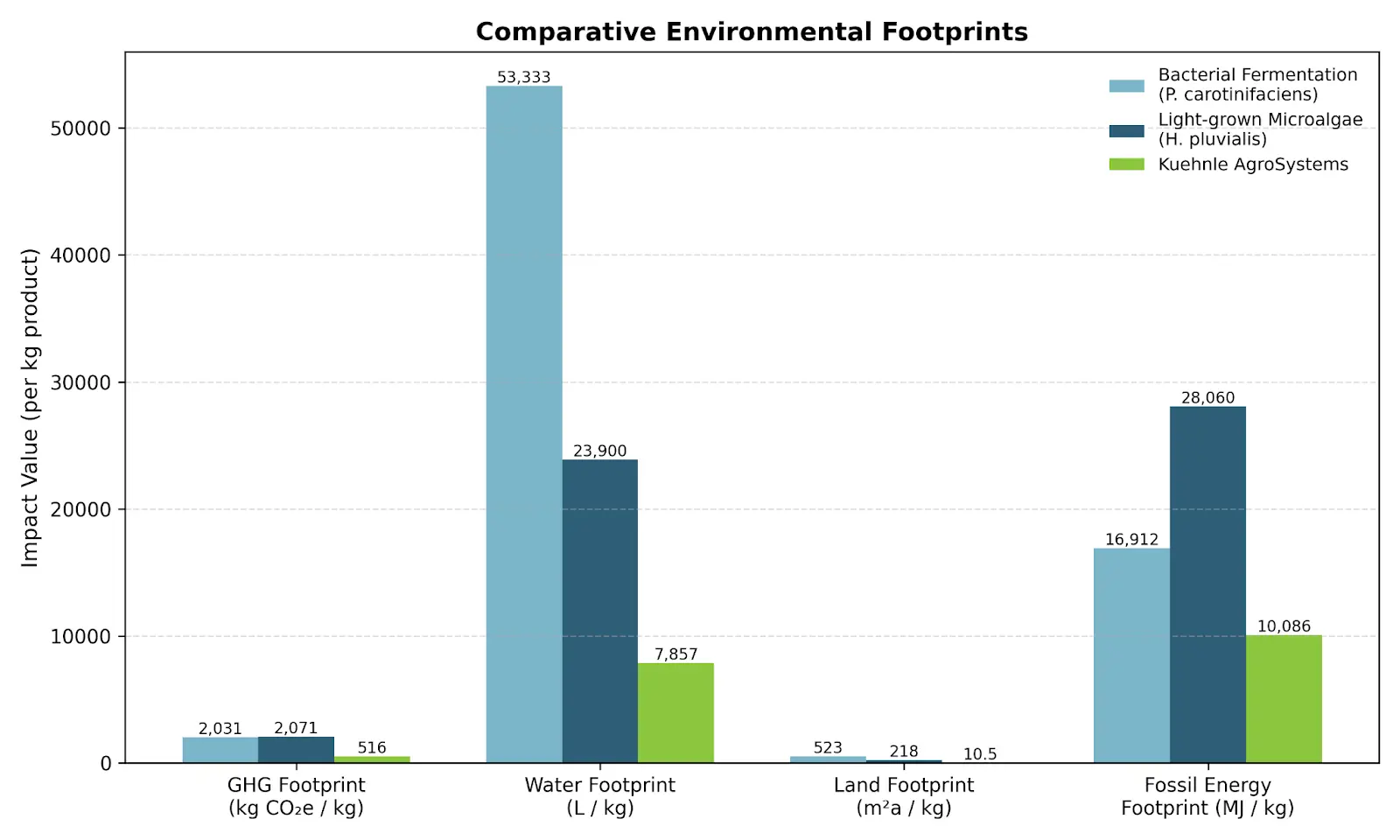
Key findings from the GHG assessment include:
- Feedstock dominance: Acetic acid production accounts for approximately 62% of KAS’s total GHG footprint and 83% of fossil energy demand.
- Decarbonization opportunity: Substituting conventional acetic acid with carbon capture and utilization (CCU)-derived acetic acid could reduce KAS’s carbon footprint by up to 27%.
- Competitive positioning: While synthetic astaxanthin production can offer certain process efficiencies, KAS’s biologically derived product demonstrates superior environmental and cost performance relative to alternative biological pathways, strengthening its appeal to sustainability-driven customers and investors.
“This assessment highlights how dramatically KAS’s dark fermentation process reduces the land, water, and energy intensity typically associated with biological astaxanthin production. By benchmarking it against existing production pathways, we were able to quantify where the real environmental gains come from and identify clear opportunities for further decarbonization.”
-Reagan Cerci
Senior Research Analyst
Boundless Impact Research & Analytics
The Outcome
Boundless' EIA validated KAS’s dark fermentation process as a far more sustainable alternative to alternative methods of astaxanthin production. The analysis demonstrated significant reductions in GHG emissions, water usage, and land use compared to bacterial fermentation and light-grown algae methods.
By pinpointing acetic acid production as a key contributor to GHG emissions, the assessment uncovered an opportunity to further reduce KAS’s environmental footprint by 27% through the use of carbon-captured acetic acid. These findings enable KAS to differentiate its product in the marketplace, attract environmentally conscious consumers, and strengthen its relationships with investors by demonstrating a strong commitment to sustainability.
“Boundless' assessment provided us with deeper insight into the sustainability benefits of our pioneering fermentation technology for astaxanthin production. Their comprehensive Life Cycle Assessment offered valuable data on our GHG emissions, water and land use, and how these metrics compare to industry benchmarks. It also identified new opportunities to further reduce our environmental footprint. Their expertise has been instrumental in helping us differentiate our product in a competitive market.”
- Adelheid Kuehnle, PhD
President, CSSO and Founder
Kuehnle AgroSystems, Inc.


