

Advancing Industrial Decarbonization: Mitico's Point-Source Carbon Capture Technology
The Problem
Industrial facilities like power plants, cement factories, and steel mills are among the world's largest contributors to climate change, with the cement industry alone accounting for about 8% of global CO2 emissions. Unlike other sectors where emissions are primarily energy-related, more than half of emissions in cement and heavy industry come from process emissions inherent to production, making them particularly challenging to abate.
Traditional carbon capture technologies often rely on hazardous chemicals like monoethanolamine (MEA) and complex processes, making them costly and difficult to implement widely. These systems typically cost over $100 per ton of CO2 captured, driven largely by high heat requirements for solvent regeneration and the need for corrosion-resistant equipment. Environmentally, they pose major challenges: MEA degrades over time, generating toxic waste and requiring frequent replenishment. Despite decades of development, traditional carbon capture technologies have only been deployed at limited scale—currently removing about 45 million metric tons of CO₂ annually, or roughly 0.1% of global emissions. However, climate models from the IPCC and International Energy Agency show it needs to capture around 1 billion metric tons by 2030 and several billion tons by 2050 to help meet global climate targets. This dramatic scaling requires innovative, safe and efficient carbon capture solutions that can be easily retrofitted to existing facilities while maintaining high capture rates and minimal environmental impact.

The Technology
Mitico's point-source carbon capture technology uses non-toxic granulated metal carbonates (Carbionik™) to efficiently capture CO2 from industrial exhaust gases. Originally developed at Caltech, their proprietary system captures 95% of CO2 from industrial emissions through a simple temperature cycling process – similar to how a rechargeable battery cycles between charged and discharged states.
The system uses cylindrical chambers called axial flow beds, which are essentially large towers (3.6m diameter x 10.8m height) filled with layers of Carbionik™ material. As exhaust gas flows through these towers, the Carbionik™ acts like a sponge, absorbing CO2 at lower temperatures (below 80°C) and then releasing it at higher temperatures (120°C) so it can be collected and stored. This simple heating and cooling cycle allows the same Carbionik™ material to be used repeatedly, with each batch lasting multiple months before needing replacement. At least three towers can operate in sequence to provide continuous capture capability.
The system is particularly well-suited for furnaces, industrial boilers, and turbines used in industries requiring onsite generation of heat, steam, and electricity – where CO2 concentrations in exhaust gas typically range from 4-18%. The modular design allows for customization to different facility sizes, configurations, and operations models while maintaining consistent capture rates above 95%.
With minimal permitting requirements and the ability to be easily retrofitted to existing facilities, Mitico's technology provides a practical pathway for industrial facilities to achieve significant emissions reductions at a low cost, while allowing clients to retain ownership of the captured CO2 and benefit from applicable tax incentives for sequestration or utilization.
The Boundless Solution – ISO-compliant Life Cycle Assessment
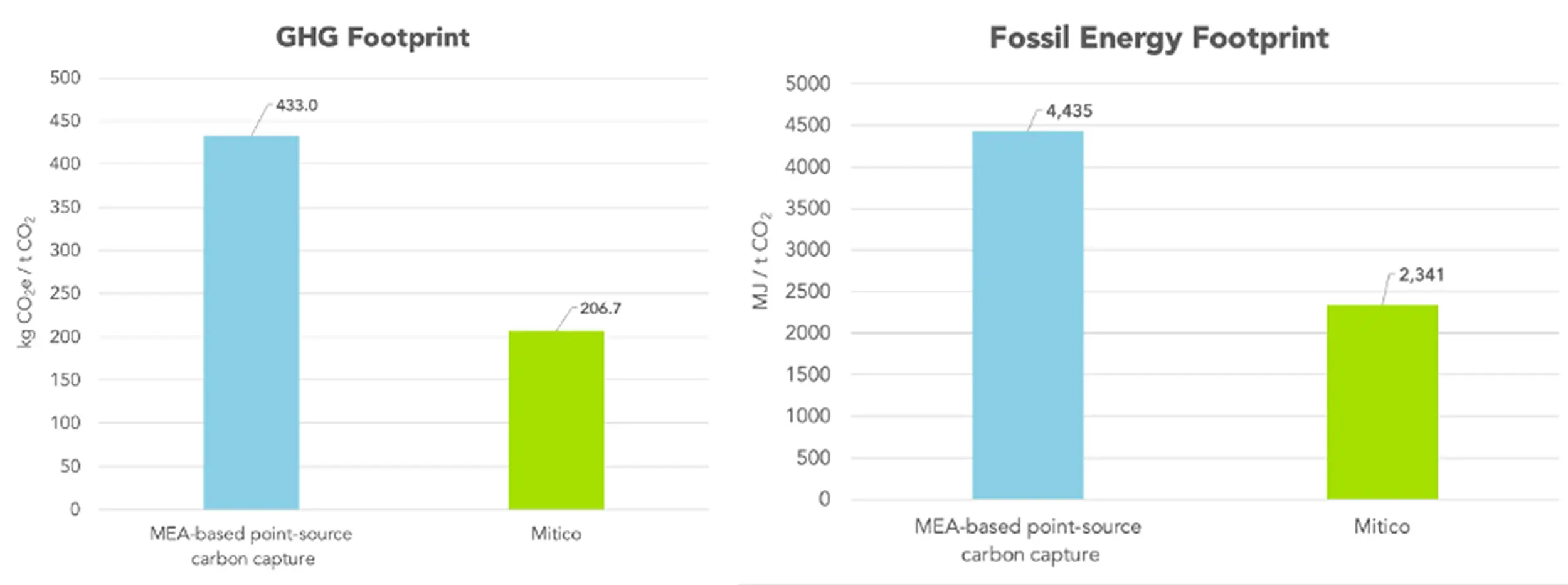
Through the US Department of Energy's ENERGYWERX program, Mitico partnered with Boundless to conduct a comprehensive ISO-compliant Life Cycle Assessment (LCA) of their carbon capture technology. This rigorous analysis compared Mitico's technology with conventional monoethanolamine (MEA)-based systems across three key environmental metrics.
Boundless’ full ISO-compliant LCA enabled Mitico to demonstrate the robustness and credibility of their environmental performance. This comprehensive analysis allowed Mitico to clearly identify the environmental benefits of their technology, such as reduced greenhouse gas emissions, and present a competitive edge over traditional carbon capture methods. The assessment provided Mitico with reliable, third-party verified data that could be used in public communications, policy engagements, and investor relations.
The assessment revealed that Mitico's technology can achieve:
- 52% reduction in greenhouse gas emissions (206.7 vs 433.0 kg CO2e per tonne of CO2 captured) (Figure 1)
- 47% reduction in fossil energy consumption (2,341 vs 4,435 MJ per tonne of CO2 captured) (Figure 2)
The Outcome
The Boundless Environmental Impact Analysis has proven instrumental in validating Mitico's technology and supporting their market growth. The ISO-compliant methodology and comprehensive data have strengthened their position with potential partners and customers.
"Mitico's carbon capture technology demonstrates significant environmental advantages compared to conventional approaches," notes Melissa Harclerode, Director of Research at Boundless. "Our analysis shows their innovative use of non-toxic chemically-selective solid sorbents and efficient process design delivers meaningful reductions in both greenhouse gas emissions and fossil energy consumption while maintaining high capture rates."
The assessment has provided Mitico with actionable insights for further optimization of their technology, particularly in areas such as electricity consumption and heat source selection. This data-driven approach continues to inform their development roadmap as they work to advance industrial decarbonization efforts globally with the release of their full-scale product: Denali, of similar dimensions to the system used in Boundless’ analysis of the Mitico process. Denali is capable of capture CO2 from small to midsize industrial boilers (8-85 MMBtu/hr) and turbines (5-50 MW).


