

One Production Line, Two Footprints: Why Different Allocation Methods Change the Answer
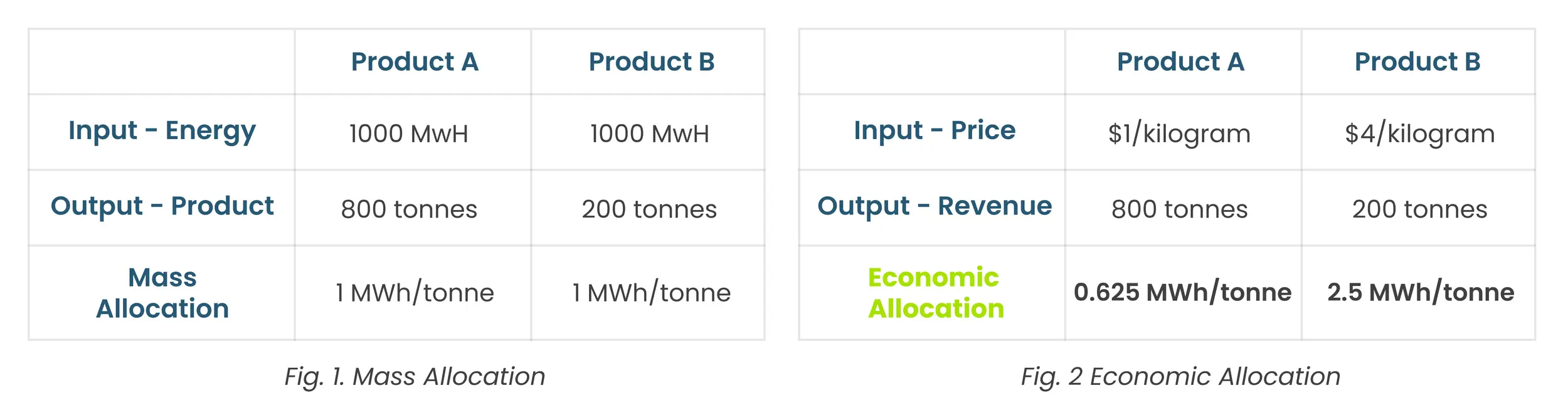
A production line uses 1,000 megawatt-hours of electricity to make 800 tonnes of Product A and 200 tonnes of Product B. If the energy is divided by mass, Product A receives 800 MWh and Product B receives 200 MWh. Both products appear to use 1 MWh per tonne. (Fig. 1)
Now add the price. Product A sells for $1 per kilogram and Product B for $4. Each product generates $800,000 in revenue, so an economic allocation divides the same 1,000 MWh equally. Product A falls to 0.625 MWh per tonne, while Product B rises to 2.5 MWh per tonne. (Fig. 2)
Nothing in the factory changed. The allocation method changed the answer.
What Allocation Does
Allocation divides the inputs and outputs of a shared process among the products that process creates. Electricity, heat, water, waste, and emissions cannot be counted in full against every product. They need a stated basis for the split.

Mass, energy content, machine time, and economic value can each be appropriate in different cases. If electricity use tracks machine hours, operating time may best reflect the physical relationship. If two outputs are sold together but have very different values, economic allocation may be useful. The defensible choice is the one that matches how the shared burden is created and is documented clearly.
How Allocation Method Affects Important Decisions
Allocation can change which product looks like the hot spot. In the example above, Product B moves from 1 MWh per tonne under mass allocation to 2.5 MWh per tonne under economic allocation. A team could choose a different product for redesign, change its pricing, or report a different footprint to a customer based on that choice.
The functional unit and system boundary matter just as much. Results reported per tonne cannot be compared with results reported per unit of service, and two products cannot be ranked if one model ends at the factory gate while the other includes use and disposal.
The Split Can Move Even When the Line Does Not
Suppose Product B's price falls from $4 to $2 per kilogram. Revenue is now $800,000 for Product A and $400,000 for Product B. Under economic allocation, the split changes from 50/50 to roughly 67/33, even if output volume and electricity use stay exactly the same.
That does not make economic allocation wrong. It means the model should show the method, test reasonable alternatives, and update when prices or product mix change. If the hot spot switches products under two plausible methods, the decision is sensitive to allocation and should be treated that way.
Where Boundless Makes a Difference
LifeCycle IQ documents the functional unit, system boundary, and allocation method used in each product model. Boundless researchers can test alternative methods and update the split as product volume, price, or process data changes.
-opt-2500.WEBP)
Allocation should never be a hidden assumption. It is part of the result.
Book a short call with our team. We'll analyze your product, uncover hot spots and opportunities, and show what LifeCycle IQ can do for you.


