

The Hidden Hot Spots in Your Supply Chain
A recycler receives an invoice for baled plastic at $500 per tonne. In reality, if only 68% of that bale becomes sellable pellet, the real material cost is about $735 per tonne of output, before washing, drying, and disposal costs are counted.
The missing $235 is not an accounting error. It’s a hot spot hidden in your supply chain.
What a hot spot actually is
A hot spot is a life cycle stage that carries a disproportionate share of a product's footprint, cost, or risk. Finding one requires looking beyond the most visible step. A Life Cycle Assessment (LCA) inventories the materials, energy, transport, and waste associated with a product from raw material extraction through disposal.
-opt-2500.WEBP)
The results often challenge the team's first assumption. In the U.S. market for biodiesel, growing crops and converting them into a form of biodiesel accounts for 61% to 88% of well-to-wheel emissions, which counts everything from growing the crop to burning the fuel. Combustion is the most visible stage, but most of the footprint is settled before the fuel ever reaches an engine.
Recycled plastic tells the same story through yield. Single-stream collection produces about 68% to 70% usable polymer, compared with 75% to 78% for dual-stream collection and roughly 85% for deposit-return material. The balance is labels, moisture, dirt, the wrong polymer, fines, and off-spec output. Every rejected tonne was still collected, transported, sorted, washed, and dried.
Why the emissions hot spot is often a cost hot spot
Cost and footprint are frequently divided by the same denominator: the tonnes that can actually be sold. At a $500 bale price, improving yield from 68% to 78% lowers the material cost of sellable pellet from about $735 to $641 per tonne. That is a difference of roughly $94 per tonne before any energy or disposal savings.
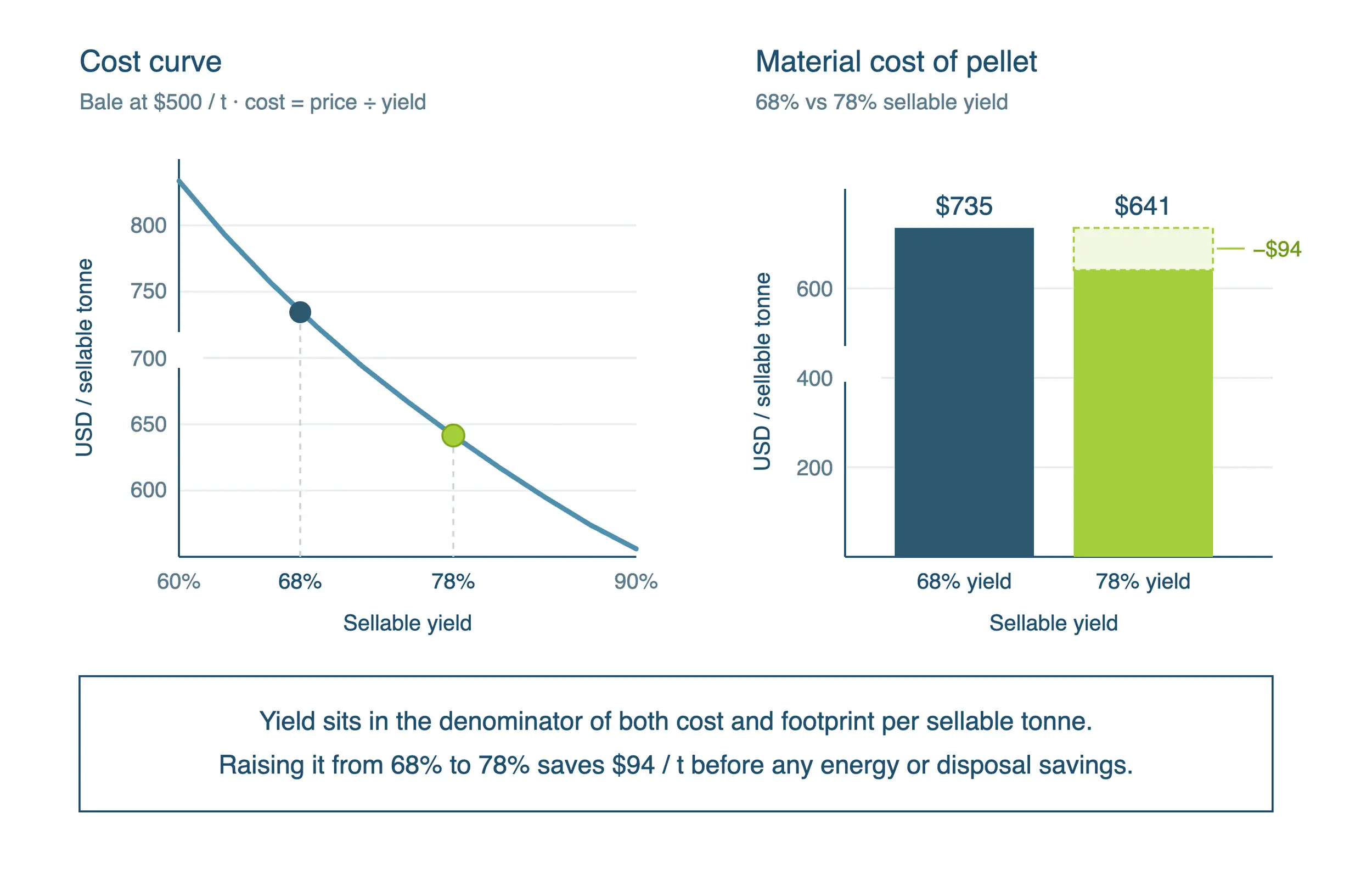
This is why a small operational change can matter more than a large improvement elsewhere. A 10% gain at a minor stage may barely move the total. A smaller gain at the stage carrying most of the burden can change both margin and footprint.
A hot spot is not permanent
Yield can move by supplier, season, collection system, and product mix. Feedstock emissions can move with soil, climate, fertilizer rate, and farm energy. A model based on last year's supplier or volume may describe a supply chain that no longer exists.
The useful question is not simply, "Where was our hot spot?" It is, "Where is it now, and what happens if we change it?"
Want the learn more?** Download our white paper, Sustainability Pays: How LCA Finds Cost and Risk in Your Supply Chain.**
Where Boundless fits
Boundless built LifeCycle IQ to answer that question with product-specific data. The platform combines ISO 14040/14044-compliant LCA with cost and supply-chain analysis, while Boundless researchers review each model. When a supplier, material, yield, or production volume changes, the model can be updated and rerun instead of rebuilt from the beginning.
That makes a hot spot a decision input, not just a finding in a report.


