

The Race For Critical Minerals Is Also A Race For Carbon Data
Securing Supply Is No Longer Enough: Buyers Now Want Carbon Data
At the beginning of 2020, Indonesia stopped exporting raw nickel ore. The government wanted the metal processed at home, instead of in China or other countries that made more money from nickel smelting, to increase the value of its nickel industry. The gamble paid off: Chinese-backed companies were forced to pour money into new smelting plants in Indonesia because nickel is a critical part of China’s EV and steel industries, and Indonesia’s share of global processed nickel supply nearly doubled, from 31.5% in 2020 to 60.2% in 2024 (S&P Global). The processing boom created more than 70,000 jobs in Indonesian nickel processing and drove rapid regional GDP growth in eastern provinces. The European Union (EU) challenged the ban at the World Trade Organization and won in 2022, but Indonesia kept it in place. Much of the new processing capacity runs on coal power, so the world’s fastest-growing source of battery nickel is also one of its most carbon intensive.
Indonesia’s bet captures both sides of today’s race for critical minerals. Every electric vehicle (EV) battery and grid storage system depends on lithium, cobalt, and nickel, and the International Energy Agency (IEA) expects lithium demand to more than triple by 2040, with demand for nickel, graphite, and rare earths growing 50% to 90% (IEA). Supply is concentrated: in 2025, the leading refining country for each key energy mineral held an average market share of 70%, and China and Indonesia together accounted for more than three-quarters of supply growth between 2023 and 2025 (IEA). That concentration has turned critical minerals into a security question for governments across the U.S., Europe, and Asia.
Now a second question sits beside the question of volume: where did the metal come from, and how much carbon does it carry? Battery makers, automakers, and regulators increasingly want that answer in writing, and the EU is turning recycled content into a legal requirement. Companies that can’t show where their metal came from, and how much carbon it carries, risk losing customers and access to the EU market.
Batteries are one of the clearest examples of a trend our November white paper traces across industries: product-level sustainability data is becoming a condition for selling into major markets, and Life Cycle Assessment (LCA) is the method that produces it.
Same Metal, Different Footprint: Nickel And Lithium Emissions Vary Up To 10x
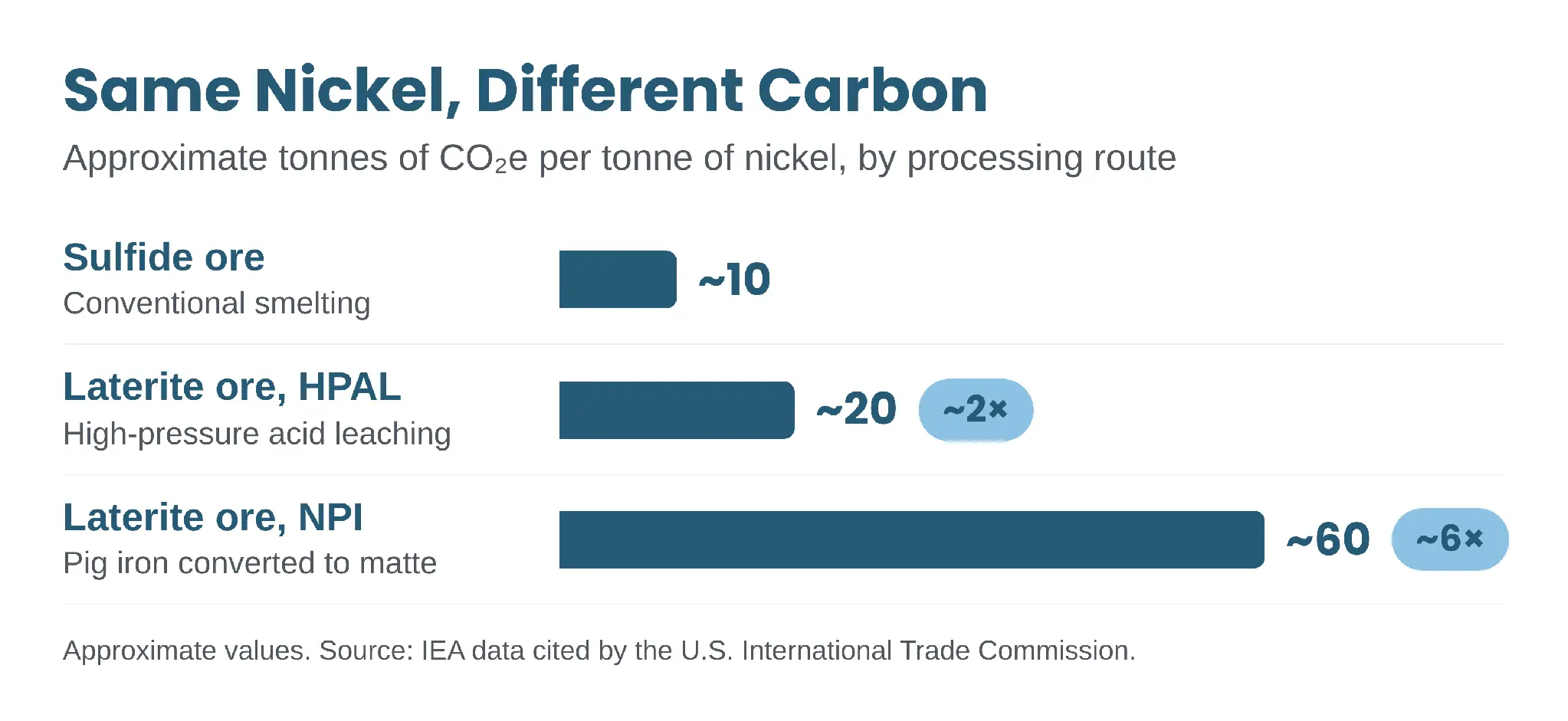
A tonne of nickel looks the same wherever it was mined, but its climate impact does not. According to IEA data, producing one tonne of nickel from the cleanest type of ore releases about 10 tonnes of carbon dioxide equivalent (CO₂e). Nickel from the type of ore Indonesia mines releases about 20 tonnes, or up to about 60, depending on how it’s processed. Indonesia’s rapid growth has run through those higher-emitting routes.
Lithium follows the same pattern. Most hard rock lithium is mined in Australia and refined in China, and lithium chemicals made from hard rock are in some cases more than three times as carbon intensive as lithium from brine sources such as those in Chile. Benchmark Mineral Intelligence also finds a more than tenfold emissions gap across the 50 largest lithium chemical operations (Benchmark Minerals). Because these differences carry straight into the finished product, a battery’s true environmental impact depends heavily on where its metals came from.
Buyers Are Asking Where Minerals Came From
Battery makers have noticed. Contemporary Amperex Technology Co. Limited (CATL), one of the world’s largest battery manufacturers, estimates that its supply chain accounts for more than 80% of the life cycle emissions of its products. Starting in 2027, CATL will require new suppliers to provide product-level environmental impact data, add renewable electricity use to its annual supplier reviews, and may give priority in order allocation to suppliers with better GHG emissions performance. When one of the largest buyers in the market writes GHG emissions data into procurement, every miner and refiner selling to it needs a number that holds up to review.
EU rules add pressure of their own. From February 18, 2027, every EV battery, e-bike and scooter battery, and industrial battery above 2 kilowatt-hours sold in the EU needs a digital battery passport, a QR-linked record of the battery’s makeup and history. From August 18, 2027, larger companies placing batteries on the EU market must also carry out supply chain due diligence on how they source cobalt, lithium, nickel, and natural graphite.
Recycled Metal Becomes Mandatory In 2031
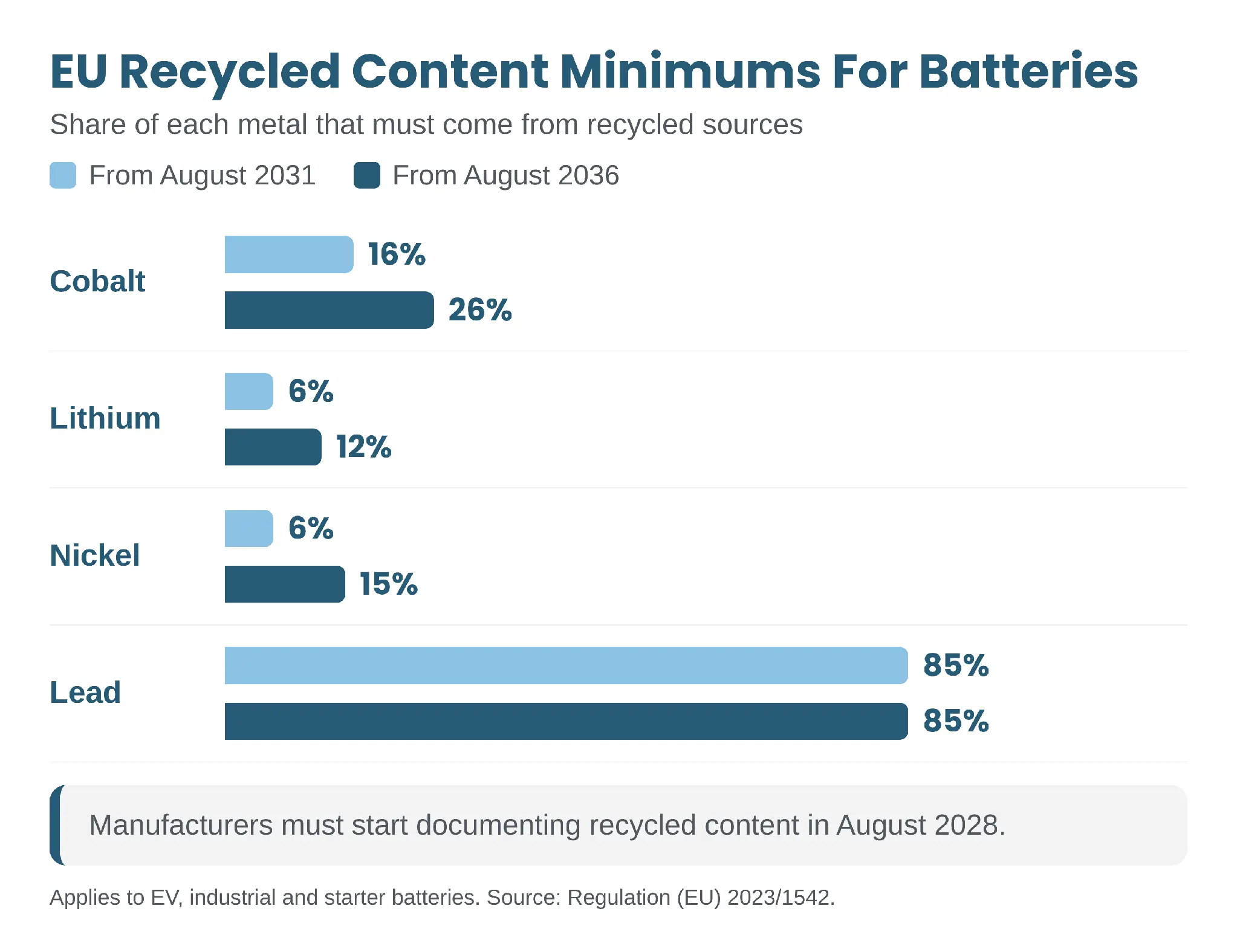
The EU Batteries Regulation goes beyond disclosure. Manufacturers of EV, industrial, and starter batteries must document the recycled cobalt, lithium, nickel, and lead in their batteries from August 2028. From August 18, 2031, those batteries must contain at least 16% recycled cobalt, 85% recycled lead, 6% recycled lithium, and 6% recycled nickel. In 2036, the minimums rise to 26% cobalt, 12% lithium, and 15% nickel, with lead staying at 85% (EUR-Lex).
The rules also reach recyclers. By the end of 2027, recyclers must recover 50% of the lithium and 90% of the cobalt, copper, lead, and nickel in waste batteries, rising to 80% and 95% by the end of 2031 (European Commission). In September 2026, the European Commission reviewed those recovery targets and concluded they remain appropriate (Council of the EU).
Together, the two sets of rules close the loop on paper: recyclers must recover more metal, and battery makers must buy it back. Recycled lithium and nickel now compete for the same supply contracts as mined metal, and both arrive with paperwork about where they came from.
The EU’s Draft Counting Rule Will Decide Who Pays For Compliance
On August 12, 2026, the Commission published a draft rule explaining how manufacturers must calculate and verify recycled content, with feedback open until September 9 (Resource Media). The draft uses a method called mass balance: recycled material that enters a factory over an accounting period is spread across everything the factory produces in that period. As a result, a battery’s declared recycled share may not match the recycled metal physically inside it.
How broadly mass balance applies decides who carries the compliance cost. Flexible rules let a manufacturer spread recycled content across production lines, plants, or even a corporate group, while strict rules require recycled feedstock to be kept separate and traced physically, which costs more. The European Battery Recycling Association (EBRA) pushed back on several points in the draft. Among them, the draft doesn’t let a company spread recycled content across its whole corporate group, and it proposes giving metal recycled inside the EU 30% extra credit (EBRA). As of mid-October 2026, the Commission had not adopted the final rules.
Whatever method the final act chooses, every claim will rest on records: traceability data on the origin and movement of recycled materials, an annual recycled content study for each battery model, and review by an independent notified body. These are the same supply chain records an LCA collects, which is why recycled content and carbon numbers increasingly come out of the same model.
China And Australia Are Building Their Own Carbon Proof Systems
The EU is not the only government asking battery materials to prove their credentials. China, which refines most of the world’s lithium and cobalt, launched a nationwide carbon declaration program for EV batteries in 2026. The program covers battery packs above 2 kilowatt-hours sold in China, makes pack manufacturers responsible for filing, and aims to finish accounting rules, standards, and certification by the end of 2026, with a goal of mutual recognition with international systems. It fits a broader plan to set national carbon accounting rules for about 100 key products by 2027, led by steel, aluminum, lithium batteries, and EVs.
Australia, home to most of the world’s hard rock lithium mining, is pairing incentives with proof. In October 2026, the government expanded its Guarantee of Origin scheme, which certifies the emissions behind Australian products, to cover aluminum and iron ore, with methodology work for more metals planned for 2026 and 2027. From July 2027, a Critical Minerals Production Tax Incentive will refund 10% of eligible costs for critical minerals processed and refined in Australia. Together, the two policies give Australian producers a reason to refine more at home and a way to prove the emissions of what they export.
Verified Product Data Is Becoming The Price Of Market Entry
Batteries show, in fast motion, the pattern our white paper traces across steel, cement, and consumer goods. The EU writes a product-level requirement, buyers carry it up the supply chain, and other governments build matching systems. Between the battery passport and due diligence rules in 2027 and the first recycled content minimums in 2031, battery materials face the same shift already under way through the Carbon Border Adjustment Mechanism (CBAM), the Ecodesign for Sustainable Products Regulation (ESPR), and the EU’s ban on vague green claims.
Customers will ask every miner, refiner, recycler, and battery maker for carbon and recycled content data. The real test is whether the answer holds up when a regulator, an auditor, or a buyer checks it. LCA built on the international standards ISO 14040 and 14044 is the method behind both numbers. Our white paper, Europe Just Changed the Rules of Global Business, covers each of these EU rules in detail and explains why verified product data is becoming the price of entry for markets well beyond Europe.
See It in Action with LifeCycle IQ
Our LifeCycle IQ platform combines product-level LCA and cost analysis, benchmarked against 450+ industries, so you can compare suppliers, materials, and scenarios in one model that updates as your product changes — instead of a static study that's outdated in months.
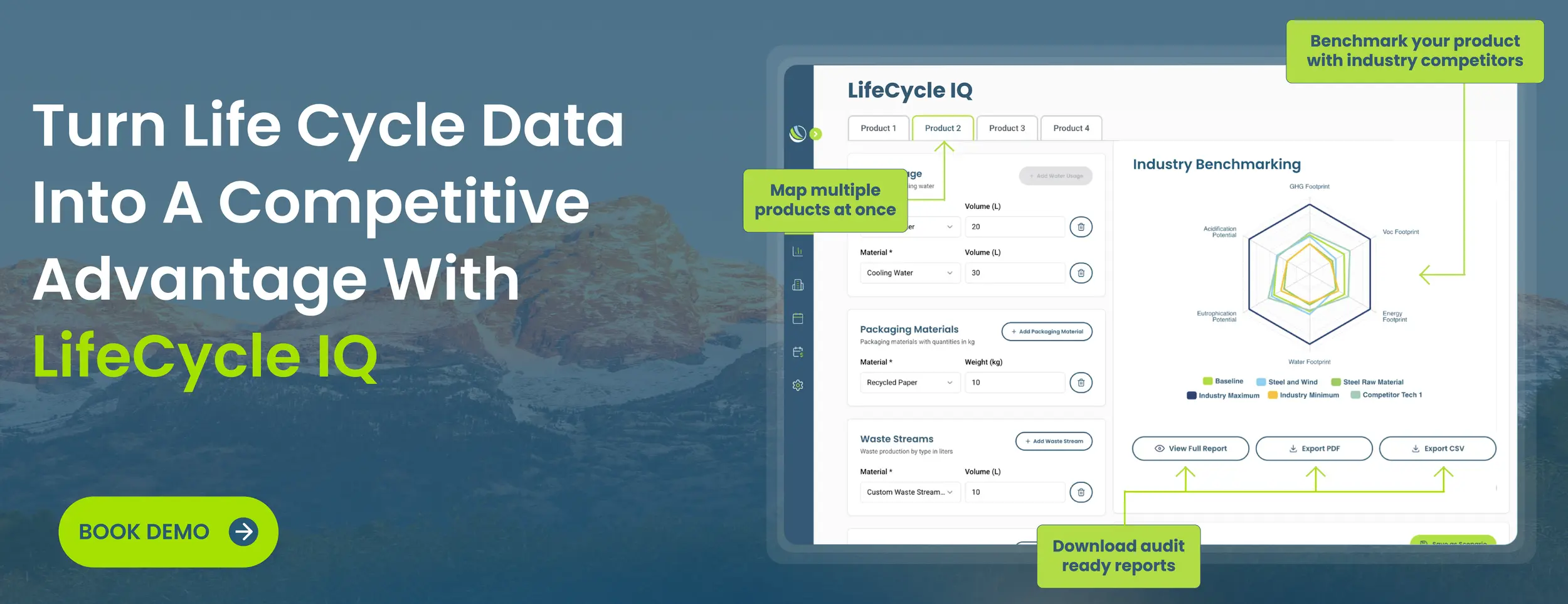
Book a short call to see how your products perform beyond carbon, from water use to particulate matter.


